Showing posts with label 3-D production. Show all posts

Sunday, May 11, 2014

A Self-Transforming Lampshade: Welcome to the World of 4D Printing!

We are starting to see more practical products designed and made with 3D printers. And in some products, 3D printing can have the added dimension of force and movement and hence, 4D printing.

Nice example.

Original post:
http://i.materialise.com/blog/entry/a-self-transforming-lampshade-welcome-to-the-world-of-4d-printing

For related resources, Design for Disassembly, Eco-Design, Environment and AD Technology guidelines related to this can be downloaded for free at:

A Self-Transforming Lampshade: Welcome to the World of 4D Printing!

ZooM is a classic 3D printed lampshade: probably a perfect match for your dining room. But if you order it from our online shop, you will receive a box with a 3D printed flat pentagon inside. So how can this function as a lampshade? The keyword to uncovering this secret is “4D printing.”

  1. 3d printed ZooM lampshade on Vimeo

    vimeo.com/91438572
    3d printed ZooM lampshade. from Michiel Cornelissen 4 weeks ago Not Yet Rated. ZooM is a 3d ...

The ZooM Lampshade was created by a Dutch designer Michiel Cornelissen. It’s composed of hundreds of geometric elements, which form a series of interlocking spirals. To make this into a lampshade, simply use standard parts that you can get from any hardware store. Once you thread a light bulb cord through the center, you will see why ZooM is so special: the pentagon pops up and transforms into a beautiful lampshade!
ZooM Lampshade by Michiel Cornelissen
This quick yet surprising metamorphosis of the ZooM lampshade was made possible by programmable material and generative design software called Grasshopper. The “fourth dimension” of 4D printing thus represents the object changing over time. This is the concept of 4D printing, which applies 3D Printing technology to produce an intelligible, self-transformable and sometimes self-assemblable object. If you want to learn more about 4D printing, watch this TED talk by an MIT researcher Skylar Tibbits, a pioneer of 4D printing.
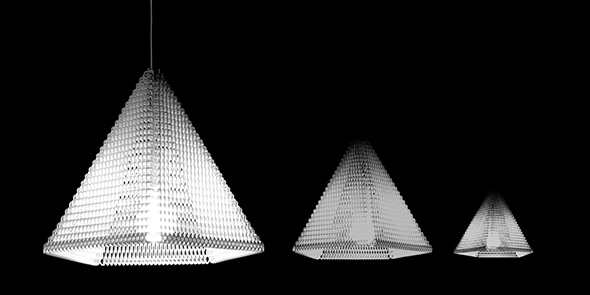
ZooM Lampshade by Michiel Cornelissen
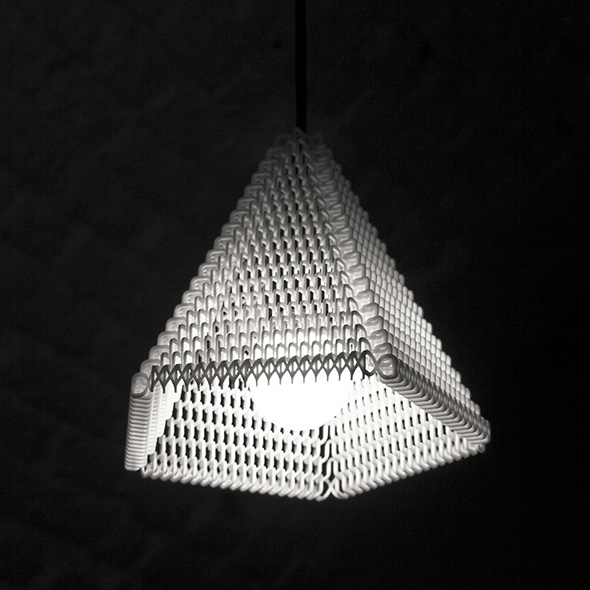
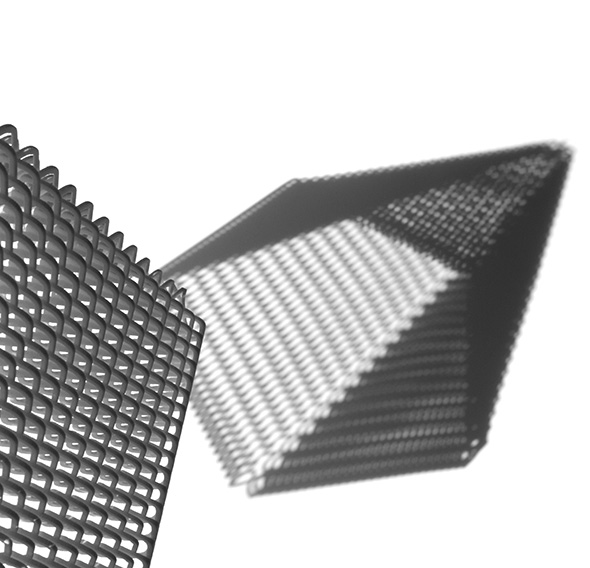
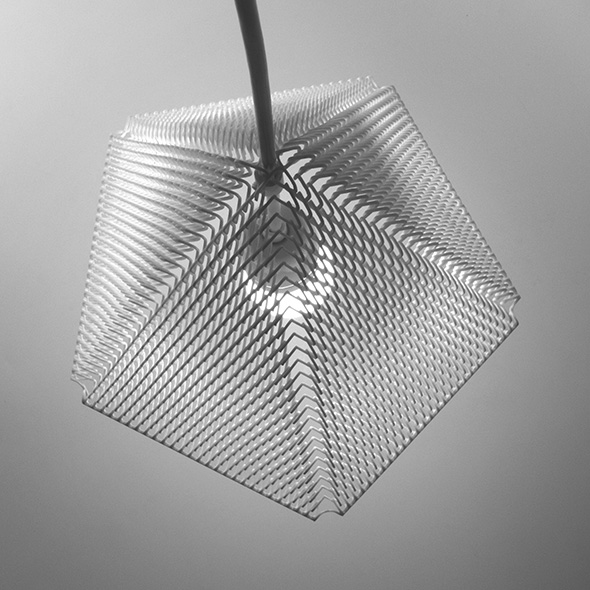
The designer of ZooM, Michiel Cornelissen has an industrial design background and hands-on knowledge in generative design, customization and 3D Printing.
“My latest passion is digital manufacturing, using technologies such as 3D Printing that can manufacture complex products without the need for large investments. The creation of products is becoming accessible to almost anyone, unprecedented form factors can be achieved, and products are becoming as adaptable and customizable as software.”— Michiel Cornelissen
You can also buy other items designed by Michiel, including the iconic Happy Bird necklacesearrings, and one of our all time favorites: the 36 pencil bowl. Already fallen in love with his fresh and smart designs? You can follow Michiel on Facebook and Twitter. Don’t miss out the evolution of 4D printing!
- See more at: http://i.materialise.com/blog/entry/a-self-transforming-lampshade-welcome-to-the-world-of-4d-printing#sthash.God5UFnI.dpuf

For related resources, Design for Disassembly, Eco-Design, Environment and AD Technology guidelines related to this can be downloaded for free at:

Saturday, March 29, 2014

3D Printing: Stuart Grover’s TEDx talk – Materialism is Dying

Stuart describes how organized "materialism is dying". This is a great tag-line and it's true, it will have significant changes in the way it will be interpreted. Philosophically, Stuart describes individual empowerment through personal choice over purchase of product provider's licensed good. But more than this, their choice to 3D print as they see fit, whatever product they require without the cost of relative complexity relative to product material mass.

From the website: http://3dprintingindustry.com/


For related resources, Design for Disassembly, Eco-Design, Environment and AD Technology guidelines related to this can be downloaded for free at:
http://www.activedisassembly.com/strategy/


TEDx talk 3d printing materialism


Stuart Grover’s TEDx talk – Materialism is Dying

3D Printing Industry BY  ON  · 3D PRINTINGVIDEOS


Technologist and entrepreneur Stu Grover believes in a future in which 3D Printing is as much a part of our lives as computers are today. To increase awareness of 3D Printing amongst everyday people, he founded 3D Printing Studios that operates as a series of street shops. With the coming of 3D Printing Stu believes we are approaching the end of materialism. Check his TEDx talk below:


  • Materialism is dyingStuart Grover at TEDxManly - YouTube

    www.youtube.com/watch?v=assSUgzfm88
    Mar 10, 2014 - Uploaded by TEDx Talks
    Stu Grover is a technologist and entrepreneur. Whilst sitting in a post grad class at the International Space ...
  • Materialism is dyingStuart Grover at TEDxManly - TEDxTalks

    tedxtalks.ted.com/video/Materialism-is-dying-Stuart-Gro

    Mar 11, 2014 - Stu Grover is a technologist and entrepreneur. Whilst sitting in a post grad class at the International Space University in early 2012 Stu Grover ...

  • Recommended articles:

    Sunday, September 1, 2013

    Made in ... Here!

    Turn over any product that you can at least lift and what do you see?

    "Made in China."

    Good, bad or indifferent. For almost all of us, it's simply not "here". Unless you're reading this in China, the situation is for them, almost an anomaly in modern labour arbitrage. Is it capitalist? Is it Communist? Is it a combination? For the ambivalent cynic, what does it matter, it's not made here. So what?

    Well, there are colossal implications across the economic, ecological, geographical, social and political spectra. But this is not an un-nuanced predicament without its benefits. Many believe that super low-cost labour is the main reason. Well, it isn't. True, labour availability is much higher. But there are many considerable factors including:
    - working conditions,
    - ecological implications,
    - currency valuations based on central bank borrowing and issuance,
    - infrastructure costs,
    - subsidized transport costs and
    - economic levers that affect the entire supply chain across the world's mass shipping practices.

    What does this mean for the one who conceives the idea, designs and makes the product here? The potential implications are huge in terms of benefits to these factors listed above. Therein lies a key feature in what has recently be coined, the 'Circular Economy' (CE). While not exclusive to the CE, there are numerous overlaps and synergetic functions. Not the least of which is...

    * ENERGY *

    Total energy output to make, pack for shipping, drive and load the freight-liner, unload and transport the goods to distribution centres and then on to your local shops or delivered via currier to your front door.

    This is where efficiency should intuitively should payoff. Almost all of this could be drastically reduced and a lot of these factors eliminated.

    And this is where local, individual and 3-D production can make a huge set of efficiency gains therefore. AKA, the craft approach to industrial design. A designer-maker has so many tools at their disposal today, rarely heard of only one decade ago. And today, circa 2013, the tools, both manual and digital are much less expensive than then. Further to this, workshop clubs offer memberships for low cost access to high-end manufacturing equipment.

    We needn't a mass production line to make goods anymore.

    And for many of these reasons above, we needn't contribute to the gravity of these consumptive production methods and supply chain practices.

    Keep on crafting.


    For related resources, Design for Disassembly, Eco-Design, Environment and AD Technology guidelines related to this can be downloaded for free at:
    http://www.activedisassembly.com/strategy/